
88 People an Hour

Today’s post is a poignant first-hand account about the staggering impacts of the dismantling of USAID from Bryce Smedley, a Former USAID Education Foreign Service Officer.
From a look at some of the countless lives changed by its abrupt closure to the sheer scope of what the United States abandoned when the Administration made this dangerous choice, Bryce’s story underscores why we’re fighting to restore USAID and other American foreign assistance programs at the Alliance for American Leadership.
The dismantling of USAID endangered lives, but it was also an abdication of American leadership on the global stage. We need your help to do this work—please consider supporting A4AL today.
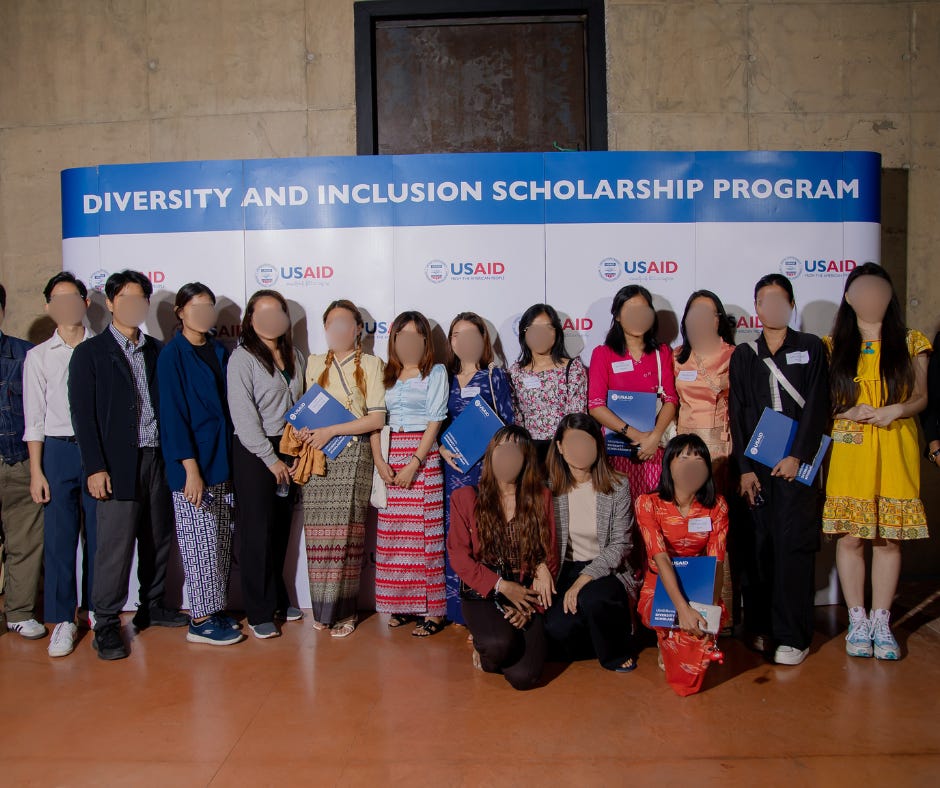
Students participating in the USAID Diversity and Inclusion Scholarship Program in Myanmar. Many came from ethnic minority and Christian communities affected by conflict and displacement. Faces have been blurred for their safety due to the risk of retaliation by Myanmar’s military government.
88 Lives an Hour
By Bryce Smedley, PhD
The scholarship had already been awarded. The student had been accepted into a technical training program in Thailand. After years of war and displacement, the future had finally become visible — not abstract, not hoped for, but scheduled. The student came from an ethnic minority community in Myanmar. He wanted to study electrical and construction trades. He planned to return home and bring electricity to villages that had spent generations without it. A landmine had already taken a limb.
He was not an edge case the program happened to reach. Reaching marginalized and ethnic minority populations was the explicit mandate. That was the point. I still look for his name in program rosters when they cross my desk.
There are none.
On July 1, 2025, USAID was closed.
The administration had ordered a 90-day freeze earlier that year: no aid disbursed unless fully aligned with the foreign policy of the President. The executive order required a genuine review of every program before any final decisions were made. That review never happened. Paul Martin, the USAID Inspector General until he was fired by two-sentence email, said so publicly. What occurred instead was a scroll through databases: any contract containing the words gender, DEI, or female empowerment was canceled. That was the review. Secretary Rubio then issued a stop work order that halted every USAID foreign assistance activity on earth. The cancellations came in full: new obligations frozen, field grants non-renewed, technical assistance terminated, mission offices shuttered across Africa, Asia, and Latin America.
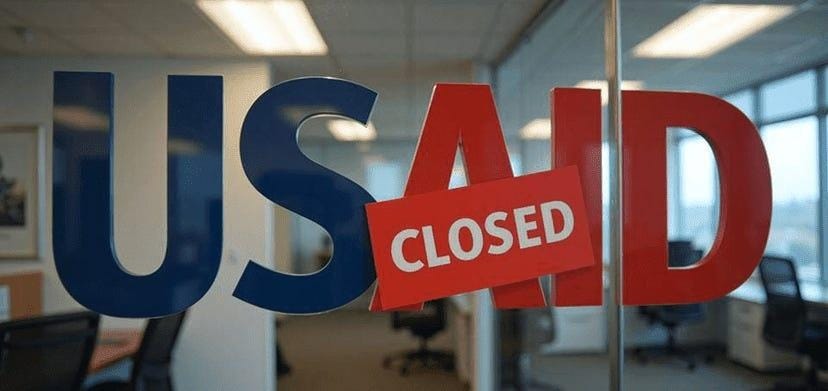
A USAID mission office after closure in 2025.
Many of us initially hoped the administration intended to modify programs, to better align them with its priorities. It quickly became clear this was something else entirely. An abrupt stop. Work ceased on projects designed for people whose lives had already been shaped by circumstances far beyond their control.
A young woman from Myanmar was studying nursing in the Philippines. She had told me her village was destroyed by airstrikes. Her home burned. She was the first in her family to reach a university, dreaming of opening an orphanage for children who had survived what she survived. Nursing programs in the Philippines are intensely competitive. She had performed so exceptionally that an exception was made to admit her. Her future was opening in ways she had never imagined possible.
In South Kivu, I met a young woman in a village savings program where each member contributed less than fifty cents a week. She borrowed enough to buy fifty pounds of beans, built a small trading business, used the income to pay her children’s school fees. She thanked us not for the money but for teaching bookkeeping. Keeping her children in school was the point. The business was how she got there.
Before leaving a village in the Kasai region, a boy of about twelve came running toward our vehicle. He had a book in his hand, one USAID had helped provide to his school. He tried English, then French, then Lingala, cycling through every language he had because he needed to be understood. It was the first book he had ever owned. He hugged my colleague and then hugged me. I have carried that moment longer than any program review I have ever read.
The last education meeting I attended before the lights went out was with a Foreign Service National colleague from Myanmar, from one of the ethnic communities our programs served. She was devastated. She worried about the children losing support, but she was equally troubled by what America was giving away. She understood the relationships built through years of trust. Those programs had produced allies whose connections to the United States lasted a lifetime. Some still believed the programs would eventually return.
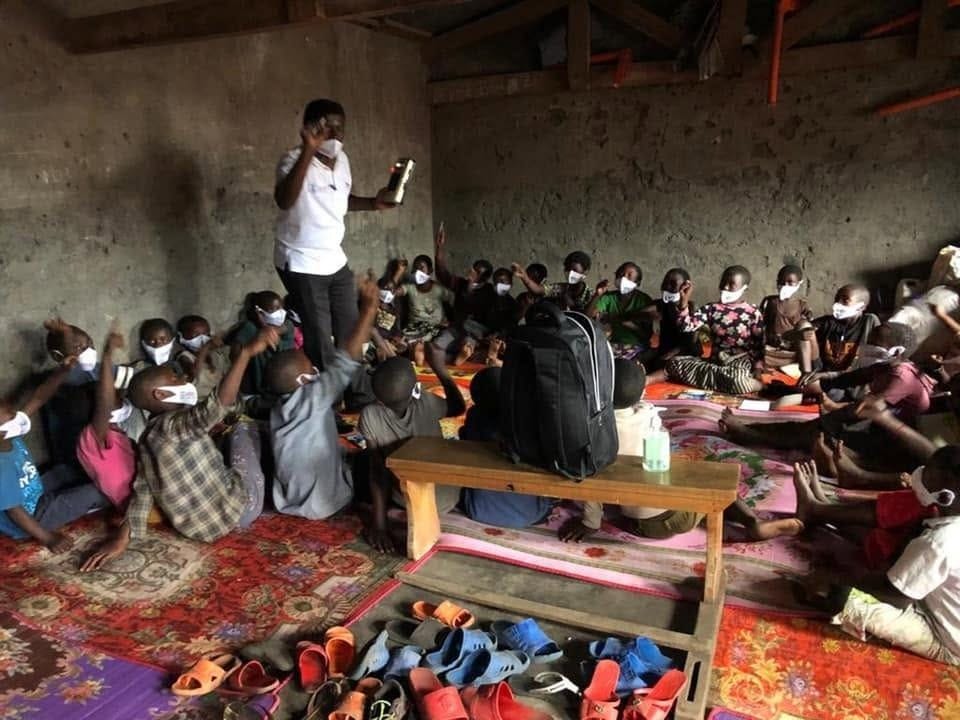
Students participate in a USAID-supported education program near Goma, Democratic Republic of the Congo, following the May 22, 2021 eruption of Mount Nyiragongo. The volcano displaced hundreds of thousands of people and disrupted education across North Kivu, leaving many children without access to school.
Boston University’s School of Public Health put the toll at 781,343 dead within a year of the cuts. Eighty-eight people an hour. The calculation tracks what happens when clean water systems lose maintenance, when vaccine cold chains break, when maternal health clinics run out of supplies. Someone sat down and did the arithmetic. Eighty-eight. Every hour. While the debate about strategic alignment continued.
When Representative Gabe Amo confronted Secretary Rubio before the House Foreign Affairs Committee in June 2026, he named one of them. Mary Sunday. Her infant daughter Santina. Kakuma refugee camp, Kenya. Santina died of malnutrition after the food aid cuts. Amo asked whether Rubio had lied when he said children were not dying on his watch. Rubio answered: “That number you’re throwing around is a false number.” He added that the mortality estimates were “an opinion of experts who got their contracts cut.”
A dead child entered as evidence. The government answered with a dispute over accounting.
Education programming does not have a mortality model. You cannot count the bodies of children who did not learn to read. You cannot calculate the precise day an uneducated population tips into a security crisis. But the scale of the erasure is not in dispute.
Between 2011 and 2021, USAID-funded education programs reached more than 140 million students. In 2024, Congress funded 396 education programs in 58 countries. When the cancellations came, those programs did not close cleanly. They stopped mid-sentence.
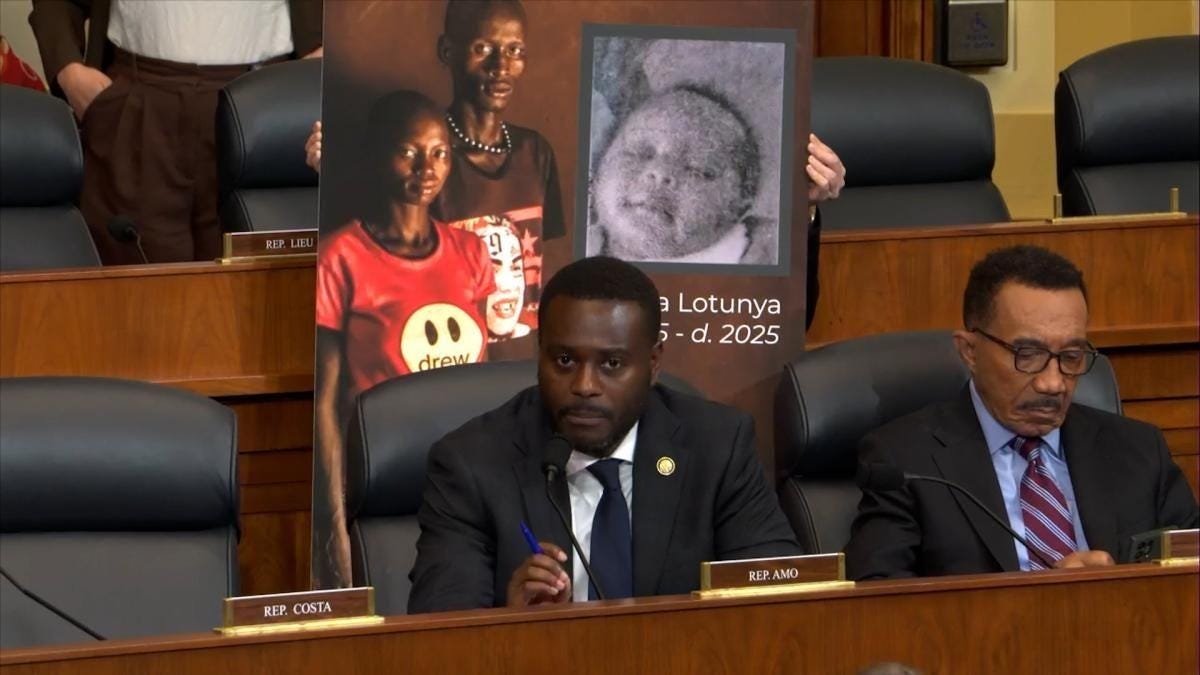
Representative Gabe Amo (D-RI) questions Secretary of State Marco Rubio during a June 3, 2026 House Foreign Affairs Committee hearing. Amo cited the death of infant Santina Lotunya after aid cuts and challenged Rubio’s claims that children were not dying as a result of the administration’s dismantling of U.S. foreign assistance programs.
In Myanmar, ethnic education leaders told me they had been approached by Chinese-linked actors asking what it would take to replace the curriculum materials USAID had been supporting. The offer came with conditions: specific language models, realigned historical narratives, integrated digital tracking systems. The leaders refused. They understood that a curriculum is a sovereignty map. But their alternative was nothing. The United States did not simply pull its money out. It pulled its values out.
Elsewhere, the damage was quieter.
An inclusive education initiative for youth with disabilities in Uzbekistan was terminated mid-cycle. In Ghana, teachers were left holding manuals for a methodology that no longer had institutional support behind it. The questionnaires measuring whether any of it had worked were still being processed when the funding stopped.
Jordan’s Early Grade Reading and Mathematics Initiative had been absorbing Syrian refugee students into the public school system for years. When the technical teams were pulled out, the classrooms remained. The children remained. What disappeared was any system for knowing whether they were learning.
Malawi offered perhaps the starkest image. Roofless brick schoolhouses, abandoned mid-construction when the wire transfers stopped, sat half-finished in the mud outside Lilongwe.
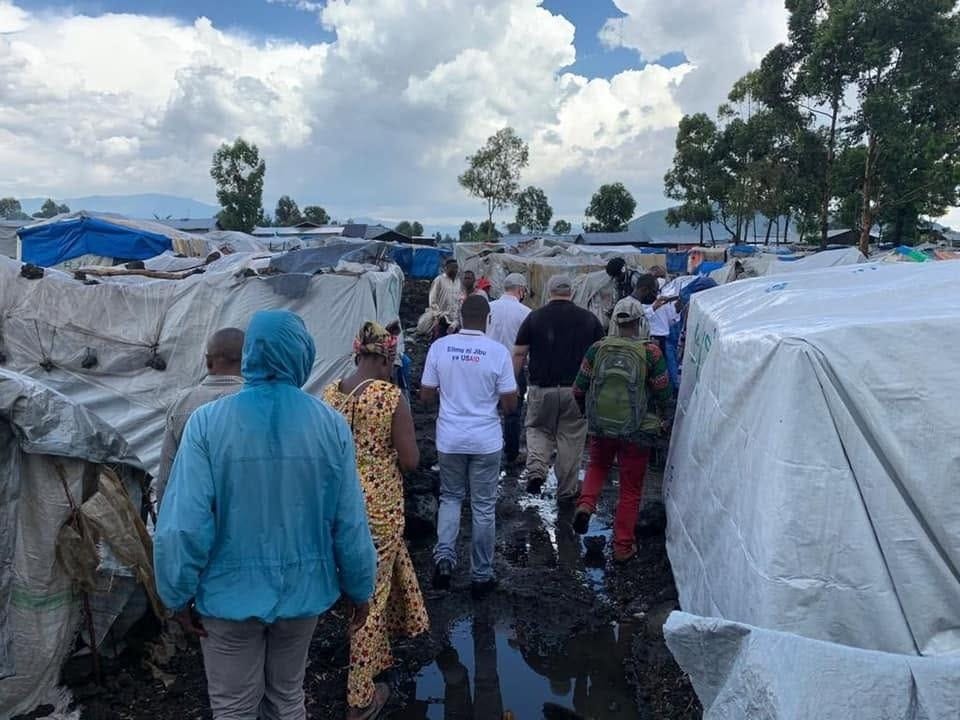
A USAID team visits a displaced persons camp near Goma, Democratic Republic of the Congo. Long before policy debates reached Washington, aid workers were already on the ground, helping communities rebuild schools and restore learning amid crisis.
The argument used to justify the dismantling was that foreign aid was charity America could no longer afford. Foreign aid was never charity. It was infrastructure. It was the mechanism by which the United States ensured that when a child in a strategic border region looked at a book, the flag on the inside cover belonged to the republic that built the school, not the empire that built the surveillance network.
The designs we built were never ours. They belonged to the ministry official who stayed late to argue for a different approach, the community elder who told us what the last program got wrong, the NGO field coordinator who knew which villages the government maps did not show. We were there to listen and build something together. Something that would still be standing after we left. The current administration replaced that with a keyword search and a delete key.
The administration had a conclusion. The people inside the programs were the evidence it did not consult.
Congress appropriated the money. The money existed. What disappeared was the system that knew how to spend it.
We built classrooms on the belief that education is a pathway to a more democratic and more prosperous future. Not because a seven-year-old could promise us anything in return. Because the promise was in the act itself.
There is a deep, generational patriotism that assumes America keeps its word, especially to the vulnerable. We promised that student with the missing limb that we would be there to help build a future, and then we walked away because the arithmetic of our compassion changed overnight. That is the hardest part of this reckoning: knowing that the America I was raised in would have honored the promise, while the America we live in now didn’t even bother to look back.
People carry an education with them for the rest of their lives. They also carry the memory of losing one.
I don’t know what happened to that student. I know what happened to the program.
One disappeared into uncertainty. The other disappeared by decision.
Bryce S. Smedley, Ph.D., served as a USAID Education Foreign Service Officer in Myanmar and the Democratic Republic of the Congo.